I asked ChatGPT, Claude, and Grok a simple question: how did the Oklahoma City Thunder’s last game go?
The difference that caught my attention was how the responses were presented. In the screenshots below, Claude and Grok gave mostly written recaps. ChatGPT put a scoreboard with team logos near the top, followed by a short explanation and a table of player performances.
I could find the result before reading the rest of the answer. On my phone, that made the response easier to scan.
That is what interests me about ChatGPT’s new Intelligent UI: the format of an answer can do some of the work of explaining it.
What is Intelligent UI?
OpenAI introduced Intelligent UI alongside its October 7, 2026 GPT-6 release in ChatGPT. It lets responses combine text, visuals, and interactive elements based on the question. A comparison can appear side by side. An explanation can use a diagram. A task can get a small tool with controls. Simple questions can still get simple text answers. 1
The useful part is choosing a format that helps someone understand or use the answer.
A Thunder recap made the difference clear
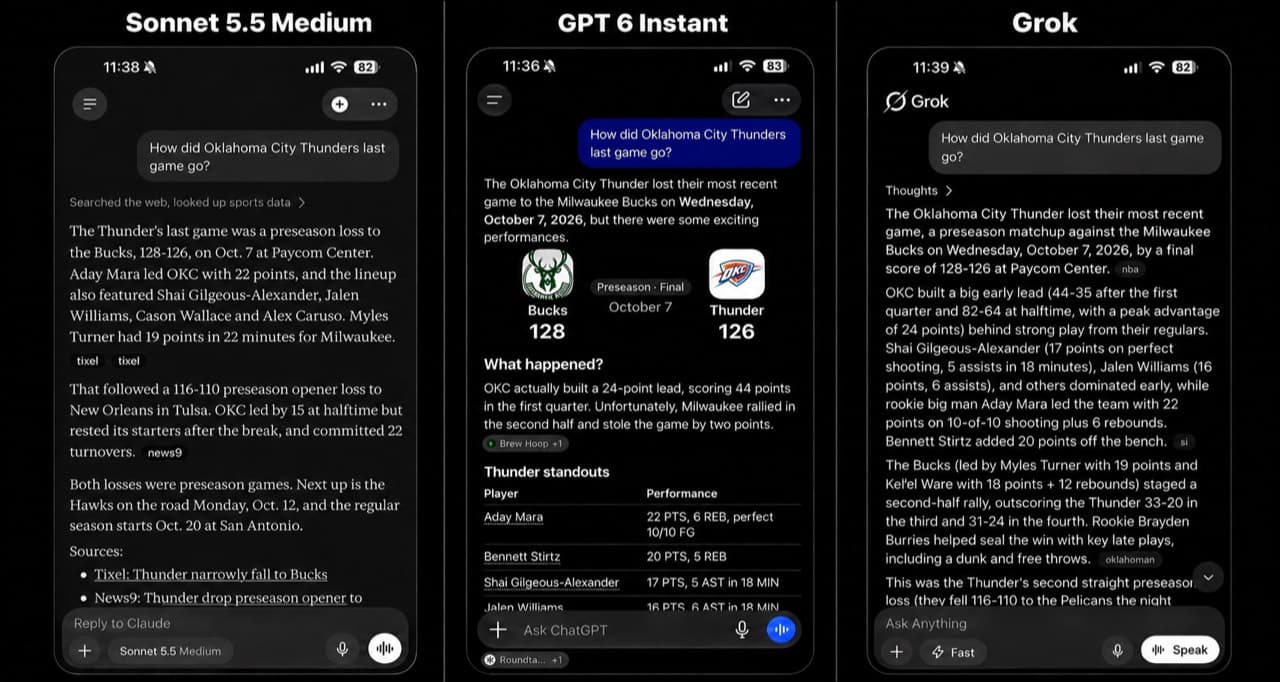
In my example, the scoreboard gave the result a clear place in the response. The player table grouped the stats so I could compare them without picking numbers out of paragraphs.
The written recap still mattered. It explained the flow of the game. The visual structure gave me a quick overview, and the text added context.
This is a small example, but it shows how layout changes the experience of getting an answer. When I ask about a game, I want the result first. Then I want to know what happened and who stood out.
This screenshot is an informal comparison of the responses I saw. It does not establish which model is more accurate or what each product can do in other conversations.
Beyond a better-looking response
OpenAI’s examples include calculators, bill splitters, and games that work inside the conversation. Those add a way to interact with the answer. 1
For something like a calculator, changing an input and seeing the result could make exploring a question much easier. I would not need to write another prompt for every variation.
That is where I see the potential: an answer can give me a useful starting point and a way to keep exploring.
Why it interests me as a developer
When I build an application, I think about what someone needs to see first, which information belongs together, and what action they should be able to take next.
Intelligent UI brings those same questions into an AI conversation.
OpenAI says the system uses a library of native components and a compiler that lets interfaces appear as they are generated. 1 My takeaway is that a shared design foundation can support responses whose layout changes with the task.
That balance matters. An interface should feel familiar while still fitting the question. More controls or visuals only help when they make the response clearer.
What I am keeping in mind
A polished answer still needs reliable information. A scoreboard or chart can make a claim look convincing, so I still want to check the source behind it.
My screenshot shows the presentation of one response. It does not demonstrate interactive controls or verify the game details independently.
OpenAI’s release notes describe a rollout beginning October 7 for paid tiers, expanding to Free and Go on October 8. They also distinguish the Pro subscription from the Pro reasoning option: Intelligent UI supports Instant through Extra High, while Pro reasoning uses Astra without Intelligent UI. This release applies to Chat; it does not change the models powering Work or Codex. 2
My first impression
The Thunder recap is a simple example of what I like about this direction. The score had a clear place, the stats were easy to scan, and the explanation was still there when I wanted more detail.
I am interested in seeing how consistently ChatGPT chooses a useful format. For me, the value will be in how much easier an answer becomes to understand and use.
Sources
- OpenAI: GPT-6 and Intelligent UI for everyone, October 7, 2026.
- ChatGPT release notes, October 7, 2026 entry.
Research checked October 11, 2026.